Showing posts with label scarves. Show all posts

Monday, April 16, 2012

More Nuno felt

   AddThis Social Bookmark ButtonI thought that I would follow up my nuno felting workshop with some photos of nuno felt work done by some of out gallery members.

Paige Garber and Roz Houseknecht try on nuno felted "boas" made by felting ruffles of wool to a central strip of silk.

                                      
My wool boa (Joanne Strehle Bast) of white wool on white silk.

 Kay Collins has used china silk, silk ribbon and merino tops wool to make the peach-colored nuno-felted scarf. Nuno-felting is called laminated felting by many felt artists.  The wool and ribbon are coaxed and imbedded through the woven silk fabric causing a ruching of materials. Hot water and olive oil soap were also used. Friction causes the fibers to migrate creating the felt cloth. The shrinking of the wool causes the ruffling of silk and ribbons which do not shrink.


 She used silk chiffon and white merino tops wool to make the peach-colored nuno-felted and hand-painted shawl.
                                      
Another of Roz's scarves felting wool flowers onto hand dyed silk.

                                      
 Nuno, hybrid or laminated felt produces a lighter weight result than an all wool product, perfect for the upcoming spring weather. Joanne


Thursday, April 28, 2011

Surface Stitchery/Embroidery #6


AddThis Social Bookmark Button
Machine embroidery has an additional possibility. Stitching may be done on a water soluble stabilizer background. When the embroidery is finished, the stabilizer is dissolved away and only thread remains. The final piece can be entirely of thread or can be part thread areas and part fabric areas. In order to do this type of machine embroidery, the background stabilizer must be stiff enough to hold up to the stitching or be suspended taut in an embroidery hoop. The stabilizing fabric comes from different companies, in different thicknesses and with different dissolving directions. Some are adhesive, allowing the placement of fabric pieces and/or yarns. Lines of stitching must cross each other so that the threads make a web that will hold up when the stabilizer is removed. Single lines of stitching as well as stitches all in a single direction will fall apart when the background is dissolved.

Joanne Bast combines recycled sweater pieces with various novelty fabrics and areas of freeform machine stitching to create scarves. A layer of thick stabilizer is cut to scarf length and width and laid out flat. Cut pieces of recycled sweater and other fabrics are positioned on the stabilizer leaving gaps to be filled with stitching. Another piece of stabilizer is positioned on top and all layers are pinned together. The use of a double layer of the stiffer variety of stabilizer allows the scarf to be stitched without hooping.

Each bar of stitchery must be stitched both up and down as well as back and forth so that it will remain intact when the stabilizer is dissolved. In this case a square grid is created, but diagonals, circles or and allover pattern of stitches could be done as well.
When the fabric pieces are secured and all the open areas have thread grids, a silk yarn hand dyed by one of our other members is stitched on top using a regular patterned stitch first on one side and then on the other.The stitched scarf is submerged in water and soaked then rinsed.
Finished scarf:

Stretching thinner stabilizer in an embroidery hoop allows for creation of an entirely thread piece. This is an iris stitched by Joanne Bast. Stitching must be done in all directions, back and forth, up and down and diagonally. Only after this base ifs formed are the design lines added on top. Note that if the bobbin thread color is changed to match the top thread, the resultant piece is the same on both sides.
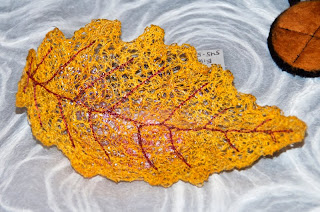
By not entirely removing the stabilizer, thread creations remain slightly stiff and can be shaped while wet. They will hold these shapes when dried. Eileen Doughty stitches and shapes thread leaves which can be used a shallow bowls to hold small items such as business cards.
Heasoon Rhee also stitches and shapes vessels of thread using a dissolvable stabilizer base. Novelty and metallic threads add sparkle.
Jewelry by Eileen Doughty is also machine stitched on stabilizer that is dissolved away. The resultant earrings are very light and wearable.
Embroidery in many ways can be used to embellish, enhance and entirely create works of art for the home and person. With Mother's Day fast approaching, perhaps one of these embroidered items of fiber art will be just the perfect gift. I will now pass the blogging hat on to Floris Flam who will enlighten, entertain and entice for the month of May. Joanne

Tuesday, November 16, 2010

Potomac Fiber Arts Gallery Holiday Jury Day

Monday November 15 was the jury day for our Holiday Treasures Show. The Potomac Fiberarts Gallery is a coop gallery that exhibits about 10 entirely new shows of fiberart each year. At the end of a show, all work is removed from the gallery and new work is submitted to a jury process before entering the gallery for the new show. Each piece is individually juried to maintain quality and relevance to fiber or a fiber technique.

The gallery is first emptied of all outgoing work.


Then the gallery is cleaned and prepared for new incoming items.Display committee member Paige Garber is sweeping the floors as Clara Graves prepares hat racks.


The jury tables are set up in the corridor outside the gallery. Racks and bags contain members work awaiting checking in which is done on the tables to the right and left. The center table seats two members of our jury committee who collaborate on passing decisions on each item. While the jurors present for the holiday show are our own members, several times a year, we invite guest jurors to gain a fresh insight. The holiday show is also our largest show in terms of number of items entered. Therefore this jury process is repeated at a second location with a second set of jurors and accessory people. I will only be showing you one. The jurors are ready to go.


Incoming work awaiting jurying.


Members Lynn Hoffman and Bev Ringel check items against inventory sheets.


Roz Houseknecht hold incoming art pieces up for the jurors to see.


Jurors Carol Holmes and Janet Stollnitz make tough decisions.


Works start coming in to the gallery.


The jury process continues.


The gallery fills.


By about 2-3PM, the jury process is finished and the gallery opens for business with a fresh new selection of fiber art and art to wear selections. Scarves and shawls:


More scarves, jackets, vests and other wearables:


Wall Art:


Purses, hats, gloves, handmade books, pillows, and more:


Jewelry, brooches, earrings, barrettes, bracelets, necklaces:


Jewelry cases for the special pieces:


We are open 10AM-6PM daily and weekends, Thursday 11AM-9PM. There will be a special Holiday Open House throughout the Torpedo Factory Art Center on December 2 from 6-9PM.We welcome your visit. Until next blog when I will continue my discussion of stitched beadwork with an introduction of brick stitch. Joanne

AddThis Social Bookmark Button